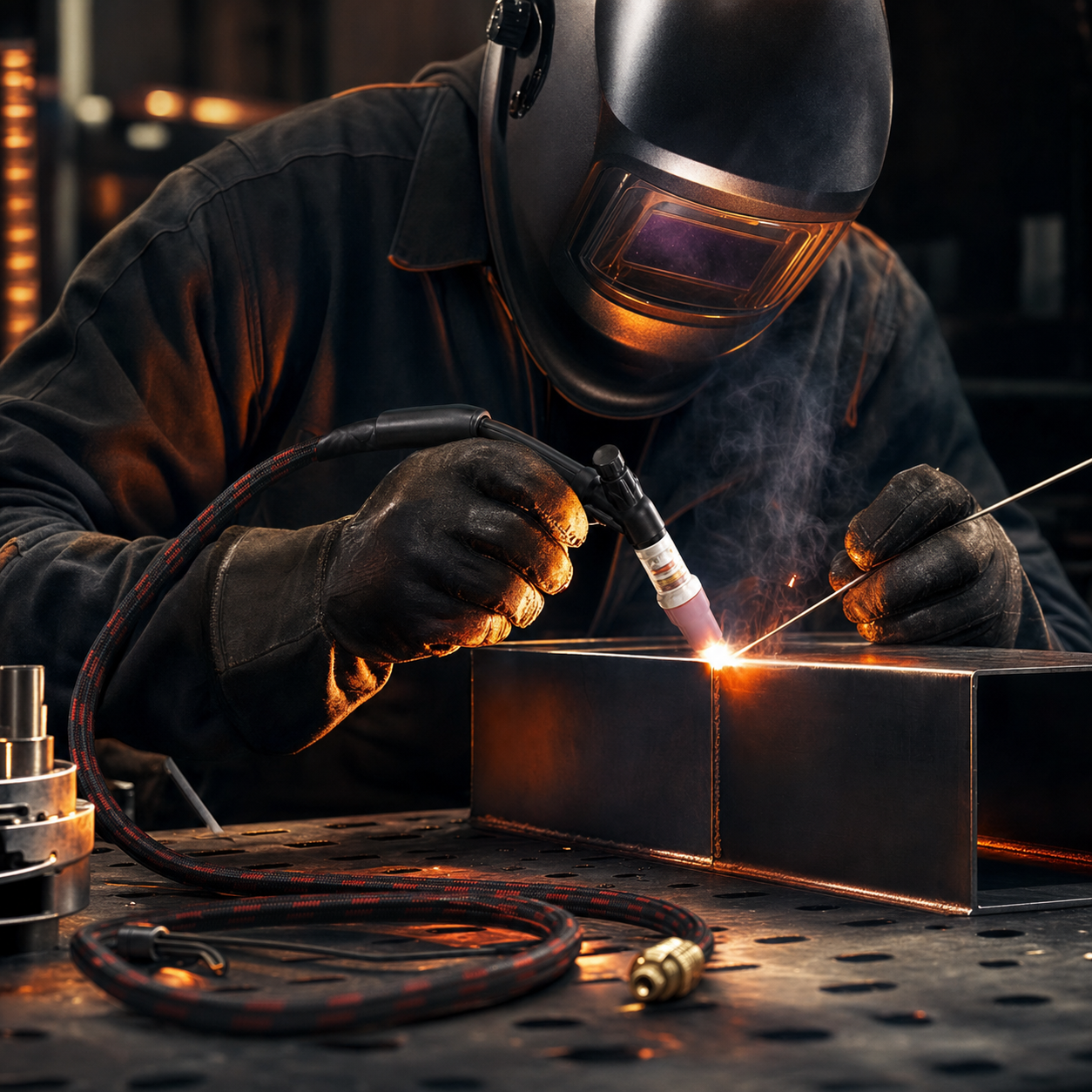
Gas-Cooled vs Water-Cooled TIG Torches: The Ultimate Industrial Thermal Management Guide
In high-precision manufacturing, metal fabrication, and aerospace engineering, maintaining absolute control over thermal dynamics is the single most important factor for achieving flawless weld beads. At the operational center of this process are TIG torches, specialized tools that direct intense electrical current, sustain stable plasma arcs, and supply precise inert gas shielding to protect the molten puddle. However, as production demands scale upward and duty cycles stretch longer, managing the heat generated by the electric arc becomes an acute engineering challenge. If a workshop utilizes inadequate thermal dissipation strategies, the structural integrity of the torch components degrades rapidly. For workshop owners, procurement agents, and manual welders alike, deciding between an air-cooled system and a liquid-jacketed assembly remains a vital decision that directly influences daily productivity, operational overhead, and equipment longevity.
Since establishing our manufacturing foundation in 2010, UPPERWELD has evolved into a trusted global supplier of highly engineered thermal apparatuses. Our comprehensive product selection spans widely used equipment, including Air Acetylene Torches, Mapp Torches, Garden Torches, and rugged industrial Heating Torches, successfully serving discerning buyers across Europe, North America, South America, the Middle East, Africa, and Australia. Built upon an unwavering commitment to international quality standards, every welding assembly we produce undergoes rigorous quality control and packaging protocols. Backed by our progressive R&D pipelines and continuous engineering innovation, we design solutions that solve the real-world operational bottlenecks of modern metal workers. In this technical deep-dive, we will thoroughly analyze the thermal boundaries, operational current limitations, and mechanical failure points of modern gas tungsten arc welding equipment to help you deploy the perfect hardware for your production line.
Gas-cooled vs. Water-cooled TIG torches: which one do I need?
Determining whether your fabrication facility requires gas-cooled vs. water-cooled TIG torches depends directly on three operational pillars: your average manufacturing current (amperage), the structural thickness of the metal alloys you fabricate, and the physical mobility requirements of your welding environment. Both cooling methodologies are highly effective when deployed within their intended engineering boundaries, but utilizing either configuration outside its structural design parameters results in immediate operational inefficiencies or sudden hardware failure.
The Mechanics of Gas-Cooled (Air-Cooled) Systems
Gas-cooled configurations—frequently referred to in the field as air-cooled systems—rely entirely on ambient room air currents and the internal flow of the inert shielding gas (typically pure Argon) to extract heat from the brass torch head and power cable. Because the cooling medium is the shielding gas itself running through a single conductor cable, these systems are mechanically straightforward, lightweight, and highly portable. There are no external plumbing lines, water pumps, or coolant reservoirs required. This makes gas-cooled options the absolute standard for field repair technicians, mobile construction operations, and workshops focused on thin-gauge sheet metal, automotive exhausts, or artistic metalwork where mobility is paramount.
The Mechanics of Water-Cooled Systems
Water-cooled configurations utilize a highly efficient three-hose closed-loop plumbing architecture to actively manage extreme thermal loads. An external water cooler or radiator unit continuously pumps liquid coolant (a specialized mixture of distilled water and low-conductivity antifreeze) through a dedicated input hose directly into specialized internal cooling jackets woven around the brass torch head. The liquid absorbs radiant and electrical heat instantly, flowing out through a return hose that encloses the main copper power cable before returning to the radiator reservoir to dissipate its thermal energy. Because liquid transfers heat up to ten times more efficiently than gas or air, water-cooled setups remain perfectly cool to the touch even during non-stop, high-current automatic or manual production cycles. They are the mandatory standard for heavy industrial fabrication plants, automated robotic cells, and structural heavy-plate manufacturing facilities.
How to Decide Which System Your Facility Needs
To pinpoint the exact cooling style your shop requires, evaluate your operational parameters against these industrial guidelines:
- Choose Gas-Cooled If: Your typical welding currents stay consistently below 150 Amps, you primarily manipulate thin materials like bicycle tubing or sheet metal, you frequently move across a large facility or job site, and you want to completely eliminate the maintenance costs, leaks, and electrical risks associated with liquid water chillers.
- Choose Water-Cooled If: Your production lines regularly run over 150-200 Amps, you consistently weld heavy structural steel, thick aluminum castings, or pressure pipes, you operate at high duty cycles where the arc stays lit for long, unbroken stretches, and your operators require a small, highly nimble torch head to navigate tight structural spaces without suffering hand fatigue from bulky insulation layers.
What is the maximum amperage for an air-cooled TIG torch?
The absolute maximum amperage for a standard industrial air-cooled TIG torch is 200 Amps DC and 150 Amps AC, which is achieved exclusively by the heavy-duty WP-26 series configuration. Beyond this 200-Amp threshold, the structural mass of copper and silicone rubber insulation required to safely dissipate heat without liquid cooling becomes too heavy and physically bulky for human hands to operate efficiently. Attempting to push an air-cooled torch beyond these engineered maximum thresholds will cause rapid thermal degradation of the internal components.
Understanding Amperage Scaling Across Air-Cooled Families
Maximum amperage ratings are not uniform across all air-cooled equipment. Instead, they are rigidly categorized by the physical frame size and structural weight of the specific torch family:
- Micro-Frame (WP-9 Series): Engineered for intricate precision applications, the maximum rating is 125 Amps DC and 90 Amps AC at a strict 60% duty cycle. It is designed exclusively for thin materials where fine control is required.
- Medium-Frame (WP-17 Series): Positioned as the universal general-purpose workshop standard, its maximum limit scales up to 150 Amps DC and 115 Amps AC at a 60% duty cycle. This family represents the absolute upper boundary for comfortable daily use on mid-range fabrication tasks.
- Heavy-Frame (WP-26 Series): Built as the ultimate heavy-duty air-cooled option, it reaches the definitive peak threshold of 200 Amps DC and 150 Amps AC at a 60% duty cycle. The torch head is significantly larger, utilizing thick copper pathways to absorb and radiate heat directly into the atmosphere.
The Crucial Role of the 60% Duty Cycle Rating
For industrial procurement teams and SEO compliance, it is critical to clarify what a "60% duty cycle" actually means under international testing criteria. A 60% duty cycle means that within a standard 10-minute production window, the torch can safely operate at its maximum rated amperage for 6 continuous minutes. Following those 6 minutes, the arc must be extinguished, and the torch must be allowed to cool down through ambient air exposure and shielding gas post-flow for a minimum of 4 minutes. If an operator attempts to run a WP-26 air-cooled model at 200 Amps continuously for a 100% duty cycle (10 full minutes of non-stop welding), the internal heat accumulation will quickly bypass the torch’s dissipation capacity, destroying the internal head threads and melting the protective rubber sleeve.
Why does my TIG torch get too hot during welding?
When high-performance TIG torches begin to overheat or become uncomfortable to hold during standard operation, it is a direct mechanical warning that the system's thermal equilibrium has broken down. Overheating is rarely a random occurrence; instead, it is caused by specific equipment mismatches, improper parameter settings, or neglected consumable component maintenance. Identifying and correcting these issues immediately is essential for preventing permanent hardware destruction and ensuring operator safety.
1. Operating Well Beyond Rated Amperage or Duty Cycle Limits
The most common cause of torch overheating is simple operator over-extension. If a technician connects a general-purpose WP-17 air-cooled torch (rated for 150A) to a machine and runs long, multi-pass fillet welds at 175 Amps, the torch will absorb heat far faster than the shielding gas and surrounding air can extract it. This mismatch causes rapid heat migration down the brass head straight into the handle sleeve. Operators must always match their torch family to the actual current demands of the project layout.
2. Inadequate Inflow of Shielding Gas or Lack of Post-Flow Cooling Time
Because air-cooled systems depend directly on the flow of inert Argon gas to assist in extracting heat from the torch body, an incorrect gas delivery setup can cause immediate overheating. If your gas flow rate is set too low (e.g., below 10 CFH), or if your shielding gas tank is running empty, the torch loses its primary internal cooling mechanism. Furthermore, neglecting to set an adequate Post-Flow Time on your welding machine prevents proper cooling after the arc is extinguished. Post-flow keeps cool argon flowing through the torch for 5 to 10 seconds after a weld is completed, which is vital for extracting residual heat from both the tungsten electrode and the copper collet body.
3. Loose Consumables or Degraded Electrical Connections
Electrical resistance creates localized heat spikes. If your TIG consumables—such as the backcap, the copper collet, or the gas lens collet body—are loose or cross-threaded inside the torch head, the electrical current is forced to jump across tiny physical gaps. This contact resistance generates intense, localized thermal energy that quickly overheats the torch body. Similarly, as the main power cable ages, internal copper strands break down from constant bending, which increases resistance along the line and causes the power lead to heat up significantly.
Technical Comparison Matrix: Gas-Cooled vs. Water-Cooled Operational Parameters
To streamline your inventory planning and assist procurement managers in choosing the right equipment, UPPERWELD has compiled this industrial engineering reference matrix comparing air-cooled and water-cooled TIG torches metrics:
| Engineering Factor | Gas-Cooled (Air-Cooled) Torches | Water-Cooled TIG Torches |
|---|---|---|
| Standard Model Families | WP-9, WP-17, WP-26 Series | WP-18, WP-20, WP-24 Series |
| Maximum Amperage Threshold | 200 Amps DC / 150 Amps AC (WP-26) | 250A (WP-20) up to 400+ Amps (WP-18) |
| Duty Cycle Capability at Max Load | 60% Maximum Cycle Standard | 100% Continuous Production Cycle |
| Physical Torch Head Footprint | Larger, Bulkier (Requires thicker insulation) | Ultra-Compact, Lightweight Micro Profile |
| Equipment Portability Factor | Excellent (Single cable, no external cooler) | Limited (Requires water chiller & plumbing hoses) |
| Average System Maintenance Costs | Low (Simple consumable replacement) | Moderate (Requires coolant, pumps, and leak checks) |
| Primary Industry Applications | Field Repair, Auto Body, Job Shop Fabrication | Aerospace, Structural Pipe, Heavy Pressure Vessels |
Troubleshooting Protocol: How to Fix and Prevent Torch Overheating
If your team reports that their TIG torches are overheating during production shifts, implement this structured industrial troubleshooting sequence to isolate the mechanical cause and prevent premature equipment failure:
- Execute an Amperage and Parameter Audit: Check the output panel of your welding machine. Verify that the operating current matches the rated capacity of your torch series. If you are running over 150 Amps on a WP-17 torch, upgrade immediately to a heavy-duty WP-26 model or transition your station to a water-cooled framework.
- Verify Thread Tightness Across Consumables: Extinguish the arc, disconnect the power source, and wait for the hardware to cool down. Disassemble the front-end consumables completely. Inspect the copper collet for warping and check the internal brass threads of the torch head for stripping. Reassemble all components, ensuring the gas lens or collet body and the backcap are fully tight to minimize electrical contact resistance.
- Optimize Gas Flow and Machine Post-Flow Parameters: Check your gas regulator flow meter to ensure pure Argon is flowing at a steady rate of 15 to 22 CFH (Cubic Feet per Hour). Navigate to your welding machine’s digital menu and increase the Post-Flow Time setting. A reliable rule of thumb is to configure 1 second of post-flow cooling time for every 10 Amps of welding current.
- Inspect the Liquid Line Integrity (For Water-Cooled Setups Only): If you are running a liquid-cooled setup and experiencing overheating, check your water chiller unit immediately. Look for kinks or blockages in the return hose, verify that the coolant fluid reservoir is filled to the maximum line, and ensure the internal water pump is generating sufficient flow pressure to cycle heat away from the torch head.
Comprehensive FAQ Section: Thermal Performance of TIG Torches
Q1: Is a water-cooled TIG torch smaller or larger than an air-cooled TIG torch?
A: Water-cooled TIG torches are significantly smaller and lighter than air-cooled models with equivalent or higher power ratings. Because water is an exceptionally efficient cooling medium, the torch head does not require heavy brass conductor blocks or thick, bulky layers of silicone rubber insulation to manage heat. For example, a 250-Amp water-cooled WP-20 torch features roughly the same compact, nimble physical profile as a lightweight 125-Amp air-cooled WP-9 torch, giving operators superior maneuverability in tight spaces.
Q2: Can I run an air-cooled TIG torch with zero shielding gas flow just for a quick tack weld?
A: Absolutely not. Operating an air-cooled torch without shielding gas flow—even for a brief tack weld—will instantly ruin your equipment. The continuous flow of argon gas is a vital internal cooling mechanism for the brass head and front-end consumables. Striking an arc with zero gas flow will instantly melt your copper collet, destroy the tungsten electrode, burn out the internal insulation, and allow atmospheric oxygen to severely contaminate your workpiece.
Q3: What kind of liquid coolant should I use inside a water-cooled TIG system?
A: You should use a specialized, low-conductivity TIG welding coolant consisting of a high-purity mixture of distilled water and deionized glycol. Never use standard automotive antifreeze or tap water inside your torch chiller system. Automotive antifreeze contains silicates and additives designed for combustion engines that will clog the tiny internal cooling channels of a torch head, while tap water contains minerals that create scale buildup, blocking flow and causing immediate torch overheating.
Q4: How does UPPERWELD ensure their air-cooled torch lines handle tough industrial duty cycles?
A: At UPPERWELD, we address thermal stress through precise material engineering and rigorous quality control. We utilize high-purity copper conductors and premium, heat-resistant silicone rubber compounds capable of withstanding unexpected temperature spikes. BACKED BY OUR ADVANCED R&D FACILITIES, every batch of torches undergoes strict thermal stress testing and packaging validation to ensure complete compliance with international quality standards before global shipment.
Partner with UPPERWELD: Future-Proof Your Global Industrial Manufacturing Supply Chain
In a global marketplace shaped by rapid technological evolution, shifting supply chains, and fierce competition, industrial profitability depends directly on equipment reliability and workshop efficiency. Sub-par thermal management, premature hardware failure, and unexpected equipment downtime can quickly drain your resources and impact your bottom line. Whether you oversee a multi-national industrial distribution network, manage a high-volume manufacturing facility, or operate an expanding e-commerce brand, partnering with an experienced, quality-focused manufacturing source is a major competitive advantage. Since 2010, UPPERWELD has built an unyielding global reputation by delivering high-tier TIG torches and specialized gas apparatuses that consistently outperform standard industry benchmarks.
We view modern market challenges as perfect opportunities to build deep, win-win-win cooperation and long-term shared success with our partners worldwide. By aligning your business with UPPERWELD, you gain direct access to our advanced engineering R&D pipelines, robust international quality compliance, and a dedicated post-purchase technical support team. Don't let inconsistent equipment or volatile supply chains restrict your workshop's production capabilities or limit your business growth.
Are you ready to optimize your wholesale procurement channels or upgrade your production line with the industry's most reliable thermal welding gear? Contact our international procurement support office today to receive customized volume-based wholesale quotes, discuss custom OEM/ODM manufacturing specifications, or explore exclusive regional distribution opportunities. Let us create, develop, and share a highly successful, high-precision future together!