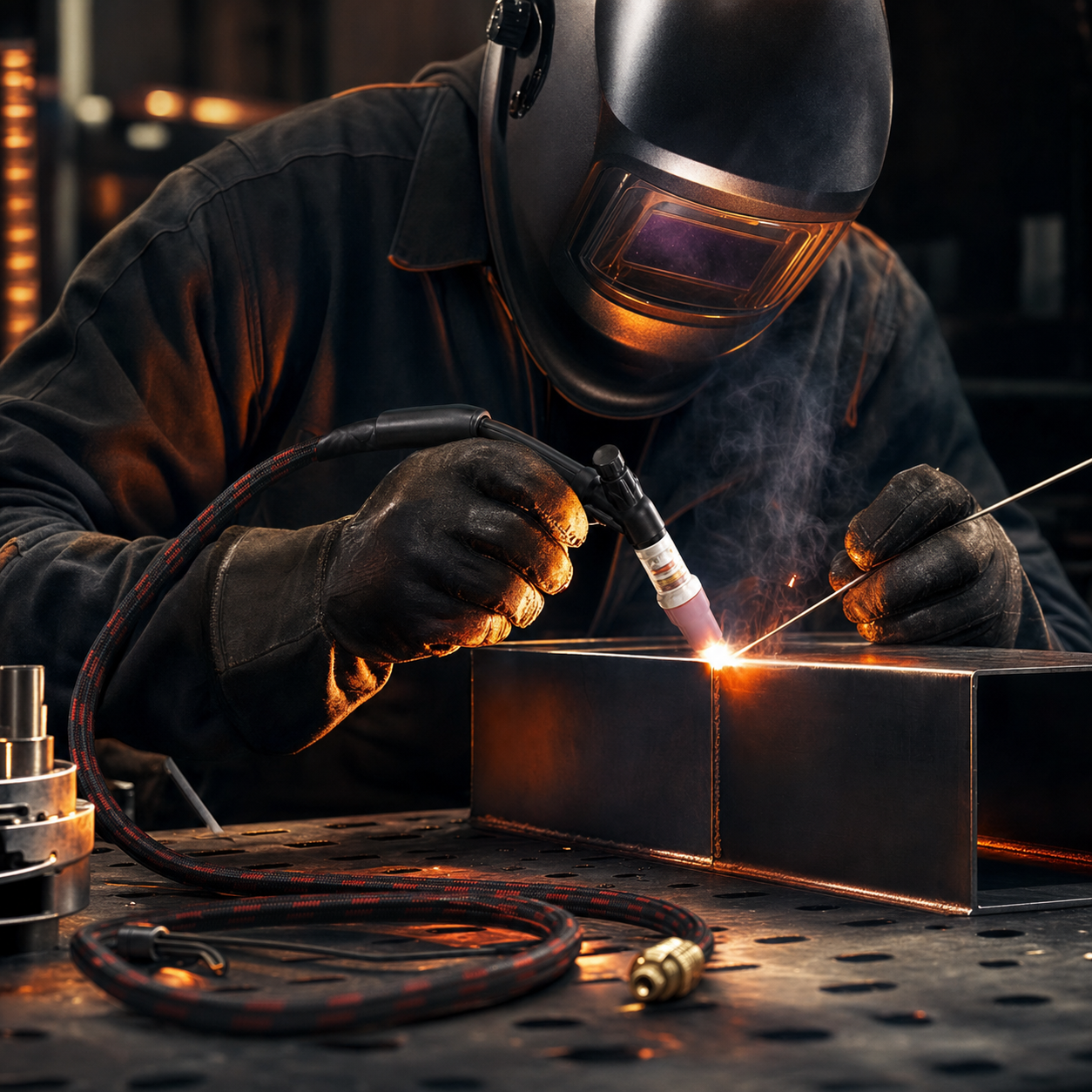
Upgrading TIG Torches: Gas Lens Benefits & Ceramic Nozzle Numbers Guide
The Complete Guide to TIG Torches Consumables: Gas Lens Benefits and Ceramic Nozzle Sizing Explained
In high-purity tungsten inert gas (TIG) welding, achieving structurally sound, x-ray quality welds relies entirely on absolute precision at the torch head. While many fabrication facilities spend thousands of dollars on advanced digital power sources, the actual quality of the weld bead is determined by the fluid dynamics of the shielding gas and the electrical conductivity occurring within the front-end consumables of your TIG torches. Even minor disruptions in the gas shield can allow atmospheric contamination, leading to porosity, brittle joints, and surface discoloration on sensitive metals like stainless steel, titanium, and aluminum. For professional manual welders, industrial welding inspectors, and global procurement managers alike, understanding how front-end accessory configurations affect gas flow efficiency is critical to reducing rejection rates, minimizing material waste, and achieving superior aesthetic and mechanical performance.
Since our structural manufacturing integration in 2010, UPPERWELD has dedicated its engineering assets to producing premium, internationally compliant thermal and welding systems. Our world-class product line features high-demand apparatuses, including Air Acetylene Torches, Mapp Torches, localized Garden Torches, and high-performance industrial Heating Torches, actively serving leading distribution networks throughout Europe, North America, South America, the Middle East, Africa, and Australia. By operating under strict international quality standards, every consumer part and assembly block we deliver guarantees outstanding reliability and long-term service stability. Driven by our active R&D division and market-oriented innovation pipelines, we develop solutions that optimize operational ergonomics and eliminate workshop bottlenecks. In this technical breakdown, we will examine the fluid dynamics and sizing classification systems governing premium torch front-ends, ensuring your facility secures flawless welding results on every shift.
What are the benefits of replacing a standard collet body with a gas lens?
The primary engineering benefits of replacing a standard collet body with a gas lens inside your TIG torches include a massive reduction in shielding gas turbulence, superior arc stability, cleaner weld beads, and the mechanical ability to extend the tungsten electrode further out from the ceramic nozzle cup. While a standard collet body is an inexpensive and functional component for basic steel fabrication, its interior design causes the protective argon gas to exit in a highly chaotic, swirling vortex pattern. This turbulent gas column quickly breaks apart, dragging ambient oxygen and moisture into the weld pool.
1. Elimination of Shielding Gas Turbulence and Swirl
A standard collet body features basic drilled holes through which the protective gas forces its way into the ceramic nozzle. This blunt fluid transition generates chaotic vortex loops. When you upgrade to a premium gas lens, you introduce an engineered internal screen pack consisting of multiple layers of micro-meshed stainless steel cloth. This mesh framework acts as a fluid straightener. As the compressed argon gas passes through these microscopic screen matrices, the turbulent vortexes are completely flattened, transforming the gas stream into a smooth, uniform, parallel column of laminar flow. This perfectly uniform shielding envelope keeps ambient atmospheric gases entirely away from the molten puddle, eliminating weld oxidation and securing beautiful, bright silver-and-gold colored weld beads.
2. Extended Tungsten Stick-Out for Deep Joint Access
Because the gas stream exiting a standard collet body degrades rapidly into turbulence, manual operators must keep their tungsten electrode tucked extremely close to the ceramic cup edge (typically no more than 1/8 inch or 3mm of stick-out). This restrictive distance makes it incredibly difficult to see the weld pool clearly when working inside tight T-joints, deep groove pipe root passes, or awkward structural inside corners. Because a gas lens creates a long, stable cylinder of laminar shielding gas, welders can safely extend their tungsten electrode up to 1 inch (25mm) or more beyond the nozzle rim without losing gas coverage. This gives the operator an unobstructed line of sight to the root of the weld joint, directly reducing operational mistakes and maximizing weld penetration precision.
3. Substantial Gas Consumption Savings
In addition to boosting structural weld quality, utilizing a gas lens across your workshop's TIG torches fleet can yield major financial savings on your shielding gas utility bills. Because the laminar column delivered by a gas lens covers the weld area so efficiently, operators can frequently lower their flow meter settings by 20% to 30% compared to a standard setup while maintaining excellent puddle protection. Over thousands of production hours, this fluid efficiency drastically cuts down on argon bottle replacement costs and maximizes your facility’s net profit margins.
What do the numbers on TIG ceramic nozzles mean?
The numbers stamped onto the exterior surface of TIG ceramic nozzles indicate the exact inside diameter (orifice size) of the front opening, calculated globally in standard increments of 1/16th of an inch. This standardized numbering classification system allows operators and procurement personnel to instantly determine the precise size of the shielding gas envelope a cup will deliver, regardless of whether the cup is manufactured from standard pink alumina ceramic, heavy-duty silicon nitride, or clear quartz glass tubing.
The Fractional Fractional Conversion Formula Explained
To convert the integer number stamped on your ceramic nozzle into a standard imperial measurement, simply place that number over a denominator of 16. To find the metric equivalent in millimeters, multiply the fractional result by 25.4. Review this clear mathematical breakdown of the standard cup number system:
- A Number 4 Ceramic Nozzle: Represents an inside diameter of 4/16 of an inch, which simplifies to 1/4 inch (approximately 6.4mm). This micro orifice is used for low-amperage precision sheet metal work where gas flow must be concentrated over a narrow area.
- A Number 6 Ceramic Nozzle: Represents an inside diameter of 6/16 of an inch, which simplifies to 3/8 inch (approximately 9.5mm). This is the absolute universal baseline standard for general fabrication workshops dealing with light-to-medium gauge carbon and stainless steel structures.
- A Number 8 Ceramic Nozzle: Represents an inside diameter of 8/16 of an inch, which simplifies to 1/2 inch (approximately 12.7mm). This wider profile is commonly paired with gas lenses to provide an expansive shielding zone for highly reactive metals like titanium and aluminum alloys.
- A Number 10 to Number 12 Ceramic Nozzle: Represents inside diameters of 10/16" (5/8 inch / 15.9mm) and 12/16" (3/4 inch / 19mm) respectively. These large, oversized cups are designed for specialized, heavy-duty industrial applications requiring massive shielding zones during high-amperage multi-pass welding.
Why Choosing the Correct Cup Number Matters for SEO and Welding Performance
Selecting the correct cup number is not an arbitrary decision; it is tied directly to your tungsten electrode diameter and your target gas flow rate (CFH). If you attempt to pass a high-volume gas stream through a small #4 nozzle cup, the gas velocity will spike dramatically, turning the gas exit into a turbulent jet that draws in atmospheric air and causes severe weld porosity. Conversely, running a low gas flow rate through a massive #12 cup will fail to create a pressurized shield, leaving the outer edges of your weld pool completely exposed to oxidation. Matching the cup number to your structural joint geometry ensures balanced gas velocity and optimum weld metal protection.
Technical Comparison Matrix: Standard Collet Body vs. Gas Lens Performance Data
To assist procurement managers and engineering team leads in visualizing the technical advantages of upgrading their TIG torches setups, UPPERWELD has compiled this comprehensive front-end component reference table:
| Performance Criteria | Standard Collet Body Setup | Engineered Gas Lens Upgrade |
|---|---|---|
| Gas Flow Characteristics | Highly Turbulent / Chaotic Vortex Flow | Perfect Laminar / Linear Columnar Flow |
| Safe Tungsten Stick-Out Limit | 1/16" to 1/8" (1.5mm – 3.0mm) Maximum | 1/4" to 1" (6.0mm – 25.4mm+) Extended Range |
| Weld Visual Aesthetics | Prone to discoloration, oxidation, heat tints | Bright, clean, mirror-like silver and gold beads |
| Joint Geometry Specialization | Flat, open surfaces only | Deep Grooves, Inside Corners, Tight T-Joints |
| Argon Gas Utilization Efficiency | Standard Consumption (Requires higher CFH) | High Efficiency (Reduces required CFH by 20%+) |
| Atmospheric Contamination Risk | Moderate to High (Turbulence pulls air in) | Near Zero (Solid protective gas column) |
Deep-Dive Engineering Analysis: Maximizing Component Compatibility
Successfully integrating premium consumables into your existing production line requires a clear understanding of hardware compatibility across different torch series. Standard air-cooled TIG torches are divided into distinct dimensional families. The small, lightweight 9 series (and its water-cooled counterpart, the 20 series) utilizes compact, miniaturized gas lenses and specific small-thread ceramic nozzles. In contrast, the universal 17 series and heavy-duty 26 series share a significantly larger backend thread structure, allowing them to utilize identical, heavy-walled collet bodies, large gas lenses, and heavy-duty ceramic cups.
When upgrading a facility to gas lens configurations, procurement managers can also choose between standard gas lenses and Large Diameter Gas Lenses (LDGL). Large diameter models feature extra-wide stainless steel screen arrays that expand the gas shielding zone even further, which is critical when fabricating exotic alloys like Inconel, Monel, and high-purity titanium for aerospace or marine applications. These materials have a high affinity for oxygen at elevated temperatures, requiring the trailing gas shield to cover the cooling weld metal long after the arc has moved forward. At UPPERWELD, our manufacturing tolerances for all gas lens assemblies are monitored using high-precision CNC multi-axis milling and automated assembly verification. This ensures our screens never separate under extreme thermal shock, maintaining stable performance throughout heavy industrial production cycles.
Industrial Step-by-Step Guide: How to Select and Assemble Your TIG Front-End Components
To avoid common workshop assembly mistakes and ensure your upgraded air-cooled or water-cooled TIG torches deliver perfect gas shielding, instruct your fabrication team to implement this strict component selection and assembly sequence:
- Select Components Based on Material Thickness: Identify your target welding current. Pick your tungsten electrode diameter based on that current, then select a matching collet and gas lens size (e.g., a 3/32" tungsten requires a 3/32" copper collet and a 3/32" gas lens body).
- Select the Correct Ceramic Cup Number: Choose your nozzle cup size based on your joint configuration. A #7 or #8 cup is typically ideal for open stainless steel joints when paired with a gas lens, while a #5 or #6 cup is better suited for tight spaces on carbon steel.
- Seat the Primary Heat Shield Insulator: Ensure the white Teflon or phenolic torch head insulator is pressed completely flat against the front face of the torch head. This creates a secure mechanical seal that prevents shielding gas from leaking out the back of the cup.
- Thread and Torque the Gas Lens: Slide your copper collet into the torch head from the front or rear, then thread the gas lens body into the front threads. Hand-tighten the component firmly, then use a small wrench to apply a gentle quarter-turn. Crucial Warning: Never over-tighten, as you risk stripping the internal brass threads of the torch body.
- Mount the Nozzle and Set Electrode Extension: Screw the numbered ceramic alumina cup onto the external threads of your gas lens body until it seats flush against the heat shield. Slide your pre-sharpened tungsten electrode through the assembly, adjust your required stick-out distance based on joint depth, and tighten your backcap to lock the entire assembly in place.
Comprehensive FAQ Section: Gas Lenses and Ceramic Cup Sizing
Q1: Can I use standard ceramic alumina cups on an upgraded gas lens body?
A: No. Standard ceramic nozzle cups engineered for basic collet bodies feature a completely different internal thread pitch and a narrower rear opening compared to gas lens cups. Because a gas lens contains a wide, multi-layered stainless steel screen mesh pack, it requires a specialized, wide-base gas lens ceramic cup to fit over the larger structural body. Always verify that your consumable inventory balances standard cups with dedicated gas lens ceramic cups to avoid assembly issues.
Q2: Why does my weld still show porosity even after upgrading to a high-quality gas lens?
A: While a gas lens creates an excellent column of laminar flow, porosity can still occur if there is a mechanical failure elsewhere in your gas delivery line. Check for the following issues: a cracked or leaking white Teflon torch insulator gasket, an excessive gas flow rate that is creating turbulence despite the mesh screens, or a loose backcap O-ring that is allowing outside air to be drawn into the argon stream. Additionally, ensure your base metal is completely free of surface oils, moisture, or mill scale before striking an arc.
Q3: What are the main differences between pink alumina ceramic cups and clear quartz glass cups?
A: Pink alumina ceramic cups are highly durable, cost-effective, and exceptionally resistant to intense radiant heat, making them the absolute standard for automated and high-amperage industrial fabrication. Clear quartz glass cups, which are used exclusively with gas lens adapters, provide the distinct advantage of absolute transparency. This gives manual welders an unobstructed view of the weld pool through the sides of the nozzle, which is highly beneficial when working inside tight tube intersections or mirrors-only structural pipe repairs.
Q4: How does UPPERWELD guarantee international standard compliance for high-precision TIG consumables?
A: UPPERWELD operates under a comprehensive, multi-phase quality control framework. From inspecting high-density raw copper and premium ceramic formulations to executing high-precision CNC machining and multi-stage packaging quality checks, we oversee every phase of production. Backed by our progressive internal R&D capabilities, we design and manufactured components that consistently withstand the heavy thermal and electrical loads of professional global workshops.
Partner with UPPERWELD: Secure a Premium, Highly Efficient Industrial Supply Chain
In a global marketplace defined by tight manufacturing margins, strict quality regulations, and intense commercial competition, optimizing your everyday hardware components is one of the most effective strategies for maintaining a strong competitive edge. Using low-grade torch consumables, poorly machined adapters, or unstable component lines can quickly lead to high rejection rates, lost production time, and reduced profitability. Whether you lead an expansive international industrial distribution network, manage large-scale commercial fabrication facilities, or operate an expanding global e-commerce brand, partnering with an experienced, quality-focused manufacturing source is a major business advantage. Since 2010, UPPERWELD has built an unyielding global reputation by manufacturing high-tier TIG torches and premium specialized gas delivery systems that consistently exceed standard industrial expectations.
We believe that modern market challenges represent perfect opportunities for deep, win-win cooperation and long-term shared success with our partners worldwide. By aligning your procurement channels with UPPERWELD, your enterprise gains immediate access to our advanced engineering R&D pipelines, rigid adherence to international quality protocols, and an unyielding commitment to comprehensive, post-purchase technical support. Don't allow sub-par hardware components or volatile supply channels to limit your production efficiency or restrict your business growth.
Are you ready to optimize your wholesale procurement channels or upgrade your production lines with the industry's most reliable and efficient welding gear? Contact our international procurement support office today to receive customized volume-based wholesale quotes, discuss personalized OEM/ODM manufacturing parameters, or establish an exclusive regional distribution partnership. Let us build, expand, and share a prosperous, high-precision future together!