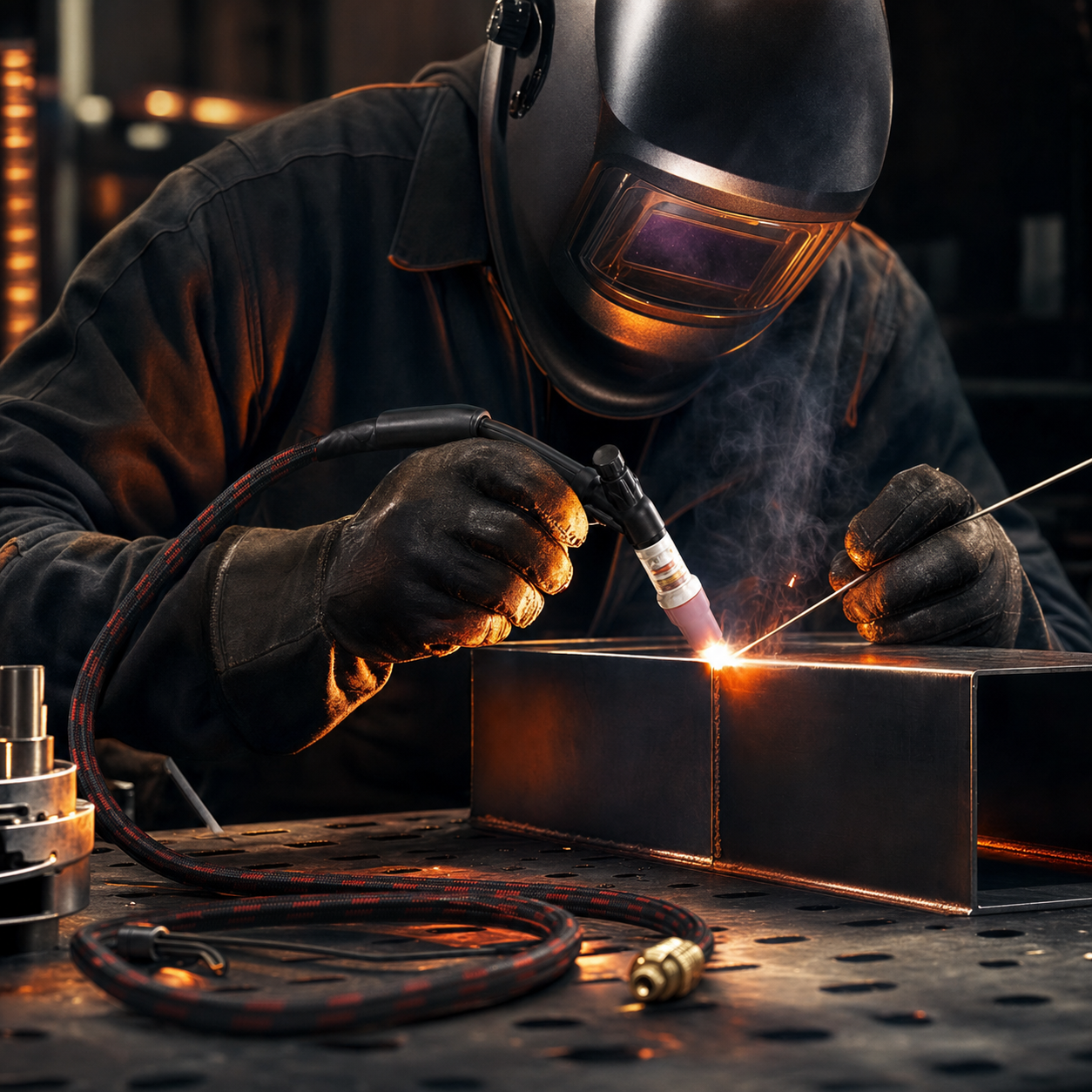
TIG Torches: Gas-Cooled vs. Water-Cooled TIG Torches, Which One Do I Need?
TIG Torches are essential tools for precision welding, and choosing between a gas-cooled TIG torch and a water-cooled TIG torch can directly affect welding quality, operator comfort, torch lifespan, production efficiency, and long-term cost. Many welders, distributors, fabrication shops, and welding equipment buyers ask the same question: should I use a gas-cooled TIG torch or a water-cooled TIG torch?
The short answer is simple: choose a gas-cooled TIG torch if you need portability, lower cost, simple setup, and light to medium-duty welding performance. Choose a water-cooled TIG torch if you need high amperage, longer duty cycle, continuous production welding, better heat control, and a smaller torch head for demanding jobs. However, the best answer depends on your welding machine, material thickness, working current, weld length, daily workload, budget, and operator expectations.

In many markets, “gas-cooled TIG torch” is also commonly called an air-cooled TIG torch. Both terms usually refer to a torch that is cooled by the surrounding air and shielding gas flow rather than by a separate liquid cooling system. A water-cooled TIG torch, on the other hand, uses circulating coolant to remove heat from the torch head and cable assembly. This difference may sound technical, but it has a big impact in real welding work.
This complete guide explains the differences between gas-cooled and water-cooled TIG Torches, how to choose the correct option, what factors matter most, and how professional buyers can evaluate TIG torch products for workshops, industrial users, and resale markets. We will also introduce key selection tables, common mistakes, maintenance tips, and a detailed FAQ section to help your website visitors make confident buying decisions.
UPPERWELD was founded in 2010 and provides a wide range of welding and heating products, including Air Acetylene Torch, Mapp Torch, Garden Torch, Heating Torch, and related torch solutions. With strong R&D and innovative capability, UPPERWELD launches new products regularly according to market requirements and focuses on strict manufacturing, quality control, packaging, and back-up service for customers across Europe, North America, South America, the Middle East, Africa, Australia, and other regions.
Gas-cooled vs. Water-cooled TIG torches: which one do I need?
You need a gas-cooled TIG torch if your welding work is light to medium-duty, mobile, occasional, or cost-sensitive. You need a water-cooled TIG torch if your work involves higher amperage, long welds, thick materials, aluminum welding, production welding, or continuous use. The right TIG torch should match your welding current, duty cycle, material type, machine capability, and working environment.
Gas-cooled TIG Torches are usually easier to use because they do not require a water cooler, coolant tank, water lines, or additional maintenance. They connect to the welding machine and shielding gas supply with fewer components, making them a practical choice for repair shops, maintenance teams, small fabrication workshops, field welding, and general TIG welding. They are also often preferred by users who need a simpler and more affordable torch setup.
Water-cooled TIG Torches are designed for heavier and more demanding welding conditions. They use circulating coolant to carry heat away from the torch head. This allows the torch to run at higher amperage for longer periods without becoming excessively hot. In many cases, a water-cooled torch can provide a smaller and more comfortable torch head than a gas-cooled torch with a similar current rating, which is valuable for precision work and long production shifts.
If you weld thin stainless steel parts at moderate amperage, a gas-cooled torch may be all you need. If you weld thick aluminum, long stainless seams, heavy-duty components, or production parts for hours each day, a water-cooled TIG torch is usually the better investment. The choice is not about which torch is universally better; it is about which torch is better for your real welding application.
| Selection Factor | Gas-Cooled TIG Torches | Water-Cooled TIG Torches |
|---|---|---|
| Best Use | Light to medium-duty welding, repair, maintenance, mobile work | High-amperage welding, production work, long welds, industrial use |
| Cooling Method | Heat dissipates through torch body, cable, air, and shielding gas | Coolant circulates through torch and cable to remove heat |
| Setup Complexity | Simple setup with fewer components | Requires water cooler, coolant hoses, and proper connections |
| Portability | High portability | Lower portability because of cooling system |
| Initial Cost | Usually lower | Usually higher due to torch and cooler system |
| Operator Comfort at High Current | Can become hot during long welds | Stays cooler and more comfortable |
| Typical Buyer | Small shops, repair users, hobby welders, mobile welders | Factories, production welders, aluminum fabricators, industrial shops |
What are gas-cooled TIG Torches?
Gas-cooled TIG Torches are TIG welding torches that rely on natural heat dissipation through the torch body, cable assembly, surrounding air, and shielding gas flow. They are commonly known as air-cooled TIG Torches. These torches do not use a separate water cooler, making them simpler, lighter in system design, and easier to move between work areas.
A gas-cooled TIG torch is usually connected to the welding machine, shielding gas cylinder or gas outlet, and sometimes a torch switch depending on the machine type. Some gas-cooled TIG Torches include a manual gas valve, which is useful for lift TIG welding machines or basic inverter welders that do not have automatic gas solenoid control. Other versions are designed for machines that control gas pre-flow and post-flow automatically.
Gas-cooled TIG Torches are popular because they offer a good balance of cost, convenience, and performance. They are often used for stainless steel fabrication, mild steel repair, thin sheet metal, automotive work, light aluminum repair, maintenance jobs, training centers, and general-purpose TIG welding.
Main advantages of gas-cooled TIG Torches
The first major advantage of gas-cooled TIG Torches is simplicity. Because there is no water cooler, the operator has fewer connections, fewer hoses, fewer possible leaks, and less equipment to maintain. This is especially useful in small workshops and mobile work environments where space and portability matter.
The second advantage is lower initial cost. A gas-cooled TIG torch does not require a water cooler unit or coolant lines, which makes the complete welding setup more affordable. For buyers who only weld occasionally or at moderate amperage, spending extra money on a water-cooled system may not provide enough practical benefit.
The third advantage is durability in rough environments. Since there are fewer cooling components, there are fewer things that can fail. A gas-cooled torch can be a dependable choice for repair work, outdoor jobs, and maintenance applications where quick setup and easy handling are important.
Limitations of gas-cooled TIG Torches
The main limitation of gas-cooled TIG Torches is heat. During high-amperage welding or long continuous welds, the torch body and cable can become hot. This can make the torch uncomfortable to hold and may shorten the service life of internal components if the torch is repeatedly pushed beyond its rated capacity.
Gas-cooled torches may also need to be larger than water-cooled torches at similar power levels because they rely on mass and surface area to dissipate heat. A larger torch head can make it harder to access tight joints or perform delicate work. For high-end precision welding, this can become a disadvantage.
Another limitation is duty cycle. Gas-cooled TIG Torches are excellent for short welds and moderate current, but they may not be ideal for continuous production lines, thick aluminum welding, or long heavy-duty welding sessions.
What are water-cooled TIG Torches?
Water-cooled TIG Torches use circulating coolant to remove heat from the torch head and cable assembly. The coolant flows from a water cooler through the torch, absorbs heat, and returns to the cooler to release that heat. This system allows the torch to handle higher amperage and longer duty cycles than many gas-cooled TIG Torches.
A complete water-cooled TIG torch setup usually includes the TIG torch, welding machine, shielding gas supply, water cooler, coolant reservoir, coolant lines, power cable, and control cable if required. Because the setup includes more components, it requires careful connection, inspection, and maintenance. However, for demanding welding applications, the performance benefits can be significant.
Water-cooled TIG Torches are commonly used in aluminum fabrication, stainless steel production, aerospace-style precision work, pipe welding, pressure vessel manufacturing, heavy equipment repair, and industrial production environments. They are especially useful when welding current is high or when the operator needs to weld for long periods without stopping.
Main advantages of water-cooled TIG Torches
The biggest advantage of water-cooled TIG Torches is heat control. By circulating coolant through the torch, heat is removed much more efficiently than with air cooling alone. This helps the torch remain comfortable and stable during longer welding sessions.
The second advantage is higher amperage capability. Water-cooled torches are often selected for welding thick materials, especially aluminum, where high current is commonly required. A water-cooled torch can support production welding more effectively because it is designed for extended arc-on time.
The third advantage is improved torch size and handling at high current. A water-cooled torch can often be smaller and easier to manipulate than a gas-cooled torch designed for similar amperage. This improves operator control and helps reduce fatigue during long shifts.
The fourth advantage is productivity. When a torch stays cooler, the welder can work longer without stopping to let the torch cool down. In production environments, this can improve output and reduce downtime.
Limitations of water-cooled TIG Torches
The primary limitation of water-cooled TIG Torches is cost. The torch itself may cost more, and the system also requires a water cooler and coolant. For occasional welders or small repair jobs, the additional investment may not be necessary.
The second limitation is setup complexity. Water-cooled systems require correct inlet and outlet connections, proper coolant level, leak inspection, and regular maintenance. If the cooler is not working correctly, the torch can overheat and become damaged.
The third limitation is portability. A water-cooled setup is not as convenient for field work because the operator must move the cooler, hoses, and additional components. For mobile maintenance teams, a gas-cooled torch is often easier and faster to use.
TIG Torches comparison: gas-cooled vs. water-cooled performance
When comparing TIG Torches, it is useful to evaluate the torch from several angles: amperage, duty cycle, comfort, cost, maintenance, portability, and welding quality. No single factor should decide the purchase alone. For example, water-cooled torches offer better heat management, but they also require more investment. Gas-cooled torches are easier to set up, but they may not be suitable for continuous high-current welding.
| Performance Category | Gas-Cooled TIG Torches | Water-Cooled TIG Torches | Best Choice |
|---|---|---|---|
| Low-amperage welding | Excellent | Excellent but may be unnecessary | Gas-cooled |
| High-amperage welding | Limited by heat buildup | Excellent heat control | Water-cooled |
| Short repair welds | Very suitable | Suitable but less convenient | Gas-cooled |
| Long continuous welds | Can become too hot | Designed for this use | Water-cooled |
| Field welding | Portable and simple | More difficult to transport | Gas-cooled |
| Production welding | Acceptable for light work | More efficient and durable | Water-cooled |
| Initial purchase cost | Lower | Higher | Gas-cooled |
| Long-term productivity | Good for moderate workloads | Better for heavy workloads | Depends on workload |
How amperage affects your TIG torch choice
Amperage is one of the most important factors when choosing between gas-cooled and water-cooled TIG Torches. The more current you use, the more heat is generated in the torch. If the torch cannot remove this heat fast enough, it becomes hot, uncomfortable, and potentially damaged.
For lower amperage work, such as thin stainless steel, sheet metal, small brackets, light repair, and short welds, a gas-cooled TIG torch is usually sufficient. These applications do not generate enough continuous heat to justify the cost and complexity of a water-cooled system.
For higher amperage work, especially thick aluminum, large stainless parts, heavy steel components, and long seams, a water-cooled TIG torch becomes more practical. Aluminum often requires more heat input than many other materials, so a water-cooled torch can help maintain comfort and stability during welding.
A practical rule is to consider not only the peak amperage of your welding machine but also how often you actually use that amperage. If your machine can output 250 amps but you normally weld at 80 to 140 amps, a gas-cooled torch may still be suitable. If you frequently weld above moderate amperage for long periods, water cooling is a stronger choice.
How duty cycle affects TIG Torches selection
Duty cycle describes how long equipment can operate within a specific time period before it needs cooling time. In real welding work, duty cycle is closely related to torch temperature and operator comfort. A torch used for short welds with breaks between passes experiences less thermal stress than a torch used continuously on long seams.
Gas-cooled TIG Torches are often suitable for lower duty cycle work. A repair welder may weld for a few minutes, stop to reposition the part, check alignment, clean the joint, or change filler rod. These natural breaks allow the torch to cool down.
Water-cooled TIG Torches are better for high duty cycle work. In production welding, the operator may weld part after part with minimal downtime. Without water cooling, the torch can heat up quickly. A cooler-running torch improves comfort and helps maintain consistent performance throughout the shift.
Material thickness and TIG Torches selection
The thickness of the material is another major factor. Thin materials require lower current and careful heat control, while thick materials require more amperage and longer welding time. This directly affects whether gas-cooled or water-cooled TIG Torches are more suitable.
For thin stainless steel, carbon steel, copper alloy, and small parts, gas-cooled torches are usually effective. Their simpler setup and good control make them practical for precision and repair work. For thick aluminum or heavy stainless components, water-cooled torches provide better heat resistance and longer operating time.
| Material or Job Type | Typical Welding Demand | Recommended TIG Torch Type |
|---|---|---|
| Thin stainless steel sheet | Low to moderate current, precision control | Gas-cooled TIG torch |
| Automotive repair | Short welds, varied positions | Gas-cooled TIG torch |
| Small fabrication parts | Moderate current, flexible use | Gas-cooled TIG torch |
| Thick aluminum | High current and heat buildup | Water-cooled TIG torch |
| Long stainless steel seams | Extended arc time | Water-cooled TIG torch |
| Industrial production welding | High duty cycle and repeated welds | Water-cooled TIG torch |
Operator comfort: why torch temperature matters
Operator comfort is not just about convenience. It affects weld quality, productivity, and safety. A torch that becomes too hot can make the welder change grip position, reduce travel consistency, increase fatigue, and stop work more often. These issues can lead to inconsistent bead appearance and reduced productivity.
Gas-cooled TIG Torches can be comfortable at lower to moderate amperage, especially for short welds. However, as heat builds up, the handle and cable may become uncomfortable. Larger gas-cooled torches can handle more heat, but they may feel bulkier in the hand.
Water-cooled TIG Torches are often preferred by professional welders who work at higher currents for long periods. Because the torch remains cooler, the welder can maintain a stable grip and better control. This is especially important for precision TIG welding, visible welds, sanitary welding, and applications where consistent bead appearance is required.
Cost comparison of gas-cooled and water-cooled TIG Torches
Cost is a major consideration for buyers. Gas-cooled TIG Torches usually have lower initial cost because they do not require a water cooler. They are also simpler to maintain, which can reduce ownership costs for light-duty users. For small workshops or occasional welding, a gas-cooled system is often the most economical choice.
Water-cooled TIG Torches require a higher investment because the buyer needs the torch, water cooler, coolant, and additional hoses or fittings. However, in high-production environments, the extra cost can be justified by higher productivity, less downtime, longer welding periods, and better operator comfort.
The best cost decision should consider total value, not just purchase price. If a gas-cooled torch is constantly overheating and slowing down production, the lower price may not be a real saving. If a water-cooled system is used only occasionally at low amperage, the extra investment may not be necessary.
| Cost Factor | Gas-Cooled TIG Torches | Water-Cooled TIG Torches |
|---|---|---|
| Initial purchase | Lower | Higher |
| Additional equipment | No water cooler required | Water cooler required |
| Maintenance cost | Lower and simpler | Higher due to coolant system |
| Production value | Good for moderate workloads | Excellent for heavy workloads |
| Best economic use | Repair, light fabrication, mobile jobs | Industrial welding, long shifts, high-amperage work |
Maintenance requirements for TIG Torches
Both gas-cooled and water-cooled TIG Torches require proper maintenance, but water-cooled systems need additional attention because of the coolant circuit. Good maintenance improves torch life, weld stability, and safety.
Maintenance tips for gas-cooled TIG Torches
- Check the torch body and handle for heat damage or cracks.
- Inspect the cable for cuts, burns, or stiffness.
- Make sure all gas connections are tight and leak-free.
- Replace worn collets, collet bodies, ceramic cups, and back caps.
- Use the correct tungsten size and sharpen or prepare it properly.
- Avoid exceeding the torch’s rated amperage and duty cycle.
Maintenance tips for water-cooled TIG Torches
- Check coolant level regularly before welding.
- Inspect coolant hoses for leaks, kinks, or loose fittings.
- Confirm that the water cooler is circulating coolant properly.
- Use suitable coolant recommended for the cooling system.
- Keep coolant lines clean to avoid blockage.
- Do not weld if coolant flow is interrupted.
- Inspect torch head temperature during operation and stop if abnormal heating occurs.
For industrial buyers, maintenance training and spare parts availability are important. Supplying consumables and replacement parts together with TIG Torches can improve customer satisfaction and reduce downtime.
Common mistakes when choosing TIG Torches
Many TIG torch problems come from incorrect selection rather than product failure. Understanding common mistakes helps buyers choose the right torch from the beginning.
Mistake 1: choosing gas-cooled TIG Torches for high-duty production welding
A gas-cooled torch may work well for short welds, but if the job requires continuous high-amperage welding, it can become too hot. In production environments, overheating slows the operator down and may reduce torch life. A water-cooled torch is usually better for this kind of work.
Mistake 2: buying water-cooled TIG Torches when they are not necessary
Water-cooled systems are powerful, but they are not always needed. If the user welds only thin materials at low amperage, a gas-cooled torch may be simpler and more cost-effective. Overbuying can increase cost and complexity without improving results.
Mistake 3: ignoring welding machine compatibility
The torch must match the welding machine’s power connector, gas connection, control plug, and cooling capability. A water-cooled torch also requires a compatible water cooler. Before ordering, always confirm machine specifications and connector requirements.
Mistake 4: focusing only on amperage and ignoring comfort
Amperage rating is important, but so is ergonomics. A large torch may handle more heat but feel uncomfortable for fine work. A water-cooled torch may offer high capacity with a smaller head, while a gas-cooled torch may be easier to carry. The best choice should consider both performance and operator comfort.
Mistake 5: forgetting consumables and spare parts
TIG Torches depend on consumables such as tungsten electrodes, collets, cups, gas lenses, back caps, and insulators. If consumables are difficult to find, users may experience downtime. Buyers should choose torch models with accessible consumables and reliable supplier support.
How to choose readable product titles for TIG Torches
Readable product titles help customers understand the product quickly and also support SEO performance. A strong product title should include the main keyword, torch type, cooling method, series, and key feature. Avoid using only model codes without explanation because many buyers may not understand them immediately.
Here are examples of readable product titles for TIG Torches:
- UPPERWELD Gas-Cooled TIG Torch for Light and Medium-Duty Welding
- UPPERWELD Water-Cooled TIG Torch for High-Amperage Production Welding
- UPPERWELD Flexible Neck TIG Torch for Precision Welding Applications
- UPPERWELD Gas Valve TIG Torch for Lift TIG Welding Machines
- UPPERWELD Air-Cooled TIG Torch for Repair and Maintenance Work
- UPPERWELD Heavy-Duty Water-Cooled TIG Torch for Aluminum Welding
These product titles are clear, keyword-rich, and customer-friendly. They explain what the product is, how it is cooled, and where it is commonly used. For Shopify product pages, this type of title can improve click-through rate, search relevance, and user experience.
Which TIG Torches are best for distributors and wholesalers?
For distributors and wholesalers, the best TIG Torches are models that cover the widest range of customer needs. A balanced product line should include gas-cooled torches for general use and water-cooled torches for industrial users. This allows sellers to serve both entry-level and professional markets.
A practical product range may include:
- Gas-cooled TIG Torches for general welding and repair users.
- Gas valve TIG Torches for lift TIG machines and basic inverter welders.
- Flexible neck TIG Torches for confined spaces and precision work.
- Water-cooled TIG Torches for industrial production and high-amperage welding.
- Consumable kits including collets, cups, back caps, and gas lens parts.
- Different connector options for popular welding machine types.
UPPERWELD supports market-oriented product development and launches new products regularly according to customer demand. For global buyers, this is important because welding markets vary by region. Customers in Europe, North America, South America, the Middle East, Africa, and Australia may have different connector preferences, packaging requirements, and product expectations.
Why choose UPPERWELD for TIG Torches and welding products?
UPPERWELD was founded in 2010 and has developed a product range that includes Air Acetylene Torch, Mapp Torch, Garden Torch, Heating Torch, and related welding and heating solutions. The company focuses on serving global markets with qualified products, strong R&D capability, strict manufacturing control, quality inspection, careful packaging, and back-up service.
For buyers looking for TIG Torches and other welding-related products, supplier reliability is a key part of the purchasing decision. A good supplier does not only provide products; it also supports stable quality, clear communication, market adaptation, and long-term cooperation. UPPERWELD adheres to international quality standards and works to improve customer satisfaction through qualified products and dependable service.
In a market filled with opportunities, challenges, and increasing competition, UPPERWELD sincerely seeks win-win cooperation with potential partners. The company aims to create, develop, and share a better future with customers, distributors, wholesalers, and industry stakeholders.
FAQ about gas-cooled and water-cooled TIG Torches
What is the difference between gas-cooled and water-cooled TIG Torches?
Gas-cooled TIG Torches rely on air, torch body mass, cable structure, and shielding gas flow to dissipate heat. Water-cooled TIG Torches use circulating coolant to remove heat from the torch head and cable assembly. Gas-cooled torches are simpler and more portable, while water-cooled torches are better for high-amperage and continuous welding.
Are gas-cooled TIG Torches the same as air-cooled TIG Torches?
In most welding markets, gas-cooled TIG Torches and air-cooled TIG Torches refer to the same general type of torch. They do not require a water cooler and are commonly used for light to medium-duty TIG welding.
When should I choose a gas-cooled TIG torch?
Choose a gas-cooled TIG torch when you need a simple, portable, and cost-effective setup for repair work, maintenance, thin materials, small fabrication jobs, and moderate amperage welding. It is also a good choice when you do not want to use a separate water cooler.
When should I choose a water-cooled TIG torch?
Choose a water-cooled TIG torch when you weld at higher amperage, make long welds, work with thick aluminum or stainless steel, operate in production environments, or need better torch cooling and operator comfort during long welding sessions.
Do water-cooled TIG Torches need a special welding machine?
A water-cooled TIG torch needs a compatible cooling system. Some TIG welding machines can integrate with a water cooler, while others require a separate external cooler. You should confirm connector compatibility, coolant flow requirements, and machine setup before purchasing.
Are water-cooled TIG Torches more expensive?
Yes, water-cooled TIG Torches usually require a higher investment because you need the torch, water cooler, coolant, and related hoses or fittings. However, for high-duty welding, the added productivity and comfort may justify the cost.
Can I use a gas-cooled TIG torch for aluminum welding?
Yes, a gas-cooled TIG torch can be used for aluminum welding, especially for thinner aluminum or short repair welds. However, thick aluminum and long AC TIG welding sessions often generate more heat, making a water-cooled TIG torch a better choice.
Which TIG torch is better for beginners?
For many beginners, a gas-cooled TIG torch is better because it is simpler, more affordable, and easier to set up. Beginners who are learning on thin steel or stainless steel usually do not need a water-cooled system at the start.
Which TIG torch is better for professional production welding?
For professional production welding, water-cooled TIG Torches are often better because they support higher amperage, longer duty cycles, and improved operator comfort. They are especially useful for repetitive welding and long shifts.
How do I know if my TIG torch is overheating?
Signs of overheating include a handle that becomes too hot to hold comfortably, discoloration near the torch head, damaged consumables, unstable arc behavior, melting or cracking insulation, and reduced torch life. If overheating happens frequently, you may need a higher-rated torch or a water-cooled system.
Do TIG Torches affect weld quality?
Yes, TIG Torches affect weld quality because they influence arc stability, shielding gas delivery, tungsten positioning, operator control, and heat management. A suitable torch helps the welder maintain a stable arc and consistent bead appearance.
What should distributors consider when buying TIG Torches in bulk?
Distributors should consider market demand, common welding machine connectors, torch series range, cooling type, packaging quality, spare consumables, product labeling, supplier reliability, and after-sales support. A balanced range of gas-cooled and water-cooled TIG Torches can serve more customer groups.
Conclusion: choose TIG Torches based on real welding needs
The choice between gas-cooled and water-cooled TIG Torches depends on the real welding application. Gas-cooled TIG Torches are the right choice for portability, simple setup, lower cost, repair work, and light to medium-duty welding. Water-cooled TIG Torches are the better choice for high-amperage welding, thick materials, long welds, continuous production, and improved operator comfort.
If your work is occasional, mobile, or focused on thin materials, a gas-cooled TIG torch can provide excellent value. If your work is industrial, repetitive, high-current, or heat-intensive, a water-cooled TIG torch can improve productivity and long-term performance. The best TIG torch is not simply the most powerful one; it is the one that fits your welding machine, duty cycle, material, operator, and budget.
Contact UPPERWELD for reliable TIG Torches and welding product solutions
If you are sourcing TIG Torches for wholesale, distribution, industrial supply, or brand cooperation, UPPERWELD is ready to support your business with qualified products, careful manufacturing, strict quality control, and dependable service. Since 2010, UPPERWELD has served customers in Europe, North America, South America, the Middle East, Africa, Australia, and other global markets with welding and heating torch solutions.
Contact UPPERWELD today to discuss gas-cooled TIG Torches, water-cooled TIG Torches, product customization, packaging requirements, bulk orders, and long-term cooperation opportunities. Let us help you build a stronger welding product line and create greater value in your market.